Posts

Showing posts with the label Apps

ActionBar and Custom Action Bar

Android ActionBar is a menu bar that runs across the top of the activity screen in android. Android ActionBar can contain menu items which become visible when the user clicks the “menu” button.

Picasso - An Android Library for Image caching, loading, resize & transform

Picasso is a library of SQUARE is used to thread and cache images asynchronously from server (Network), local storage (Disk or Memory) with some other cool functionalities like transform and resize of images. Normally, when we are working with images in mobile application, images loading is an pity issue. When application need to load many images at a time like in list-view or spinner, so due to huge load of it application may slow , crash due to not enough memory or scrolling issue than Picasso will help you a lot as well when you need to make a thumbnail of a heavy image.

Menus - Option Menu (Menu and App Bar)

Image
It is the basic structure of menu item for an activity.

Scrolling Activity - Activity Scroll

Image
The scrolling activity give a perfect and eye scathing view, in case when activity is long.

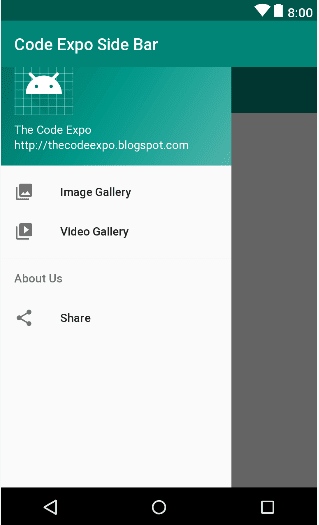
Side Bar - Navigation Drawer

Image
Used to penalize the top level menu of application.

Bottom Navigation Bar - Tabs

Image
Bottom Navigation Tabs is Bottom Tier/Layer of tabs, to perform some function when user click this tabs. It consists of three to five tabs. Normally we load fragment on tap of this tab. Tabs is designed with icon and its name in text.

SQLite Database Update Operation Query

If we want to update the recored in sqlite Database we have two condition to update it.

Database Operation Part 02 - Update and Deletion

Android Studio SQLite as a DBMS. Here we will discuss Update and Delete operation from CRUD operation of Database.

Database Operation Part 01 - Insertion and Selection

Image
Android Studio SQLite as a DBMS. Here we will discuss Insert and Select operation from CRUD operation of Database.

Instant Run in Android Studio

Image
Previously we discussed,  How to Run Android Application?  Here we will discuss the Android Studio instant run feature.

Make a Phone Call & Dial Number Using Intent

Intent is asynchronous message between components of application or with other application. Here we will call and feed number to dial-pad from our application to the Android System default Calling application using Intent.

User Permission - Install and Run time Permission

To use sensitive feature or data of Android System or User, application must get permission of doing it. It;s the privacy of Android System User. Depend on system feature, if its not much harmful for user than get it during installation, otherwise application need to get it using popup before using the feature at run time.

Content Provider - How to get data from Content Provider?

It is a shared set application data, stored on a steady and persistent storage like file, web, Database etc. Other application can query the application on request.

EditText Remove Focus - Hide & Show Keyboard

EditText have the highest priority of focus. Keyboard quick show up, when an Activity have an EditText in any place without in notice of others view of it. When we need to remove focus or to show keyboard when required, we have two methods to follow for achieving it.

Rounded Background of View - EditText, Button Circular Background

Make XML file in  res/drawable/rounded_edittext.xml

Sign Up Screen - Form

Image
Here we will design a Sign Up Screen. Normally this consists of User detail and Password EditText and a Sign Up Button. Note that In the code the resources used in XML code is the local resource of author. User must need to place the resources with same name or change name of it in code. Resources includes drawable images, color and strings.

Login Screen - Form

Image
Here we will design a Login Screen. Normally this consists of User Name or Email and Password EditText and a Login Button. Note that In the code the resources used in XML code is the local resource of author. User must need to place the resources with same name or change name of it in code. Resources includes drawable images, color and strings.

Android Application Component - Activity, Service, Broadcast Receiver, Content Provider

Application Components are the essential factors of application. Each can be entrance to the application. Each must be register in AndroidManifest.xml file with short detail like intent-filter etc. and interaction of them.

User Interface Design Tags & Its Attributes

Android Design is based on XML design which consists of tags and its attributes. XML is the advance form HTML. Here is the short introduction of XML tags and attributes. RelativeLayout is the container which its child relative to each other or relative to itself. like At bottom, vertical center, left to some other button or text etc.  LinearLayout is the container to place its child vertical or horizontally one after another. android:layout=”vertical” or android:layout=”horizontal” is used to place its child vertically and horizontally. Button tag is used to create Button, TextView for label, ImageView for Image holder, ImageButton for Image and Button combination like view, RadioButton for options to choose one between then, CheckBox for multiple options selection for multiple, ListView to populate list like contact list, GridView to make Grid of View image Gallery Grid.

Intent

It's asynchronous message among components of application or with other application. Component of application includes Activity, Service and BroadcastReceiver. Android application components(Activity,Services,BroadcastReceiver) can connect other components or to other Android applications. Intents is a built in class of the android.content.Intenttype. We can send them to the Android system defining the components you are targeting for example Android application components(Activity,Services,BroadcastReceiver) or other application.